
Currituck Beach Lighthouse may be the only one of its kind that still has the option to double-close a door to either the watch room or the outdoor gallery. All thanks to just one wooden door which can swing to close off the metal parapet doorsill that leads to the outside gallery or the watch room vestibule that leads to the space under the lens.
The Vestibule to the Watch Room at Currituck Beach Lighthouse
Original metal specifications for the towers like Currituck Beach specified that the vestibule to the watch room was:
“provided with two wooden doors…[one] shutting in one way against a suitable rebate strip riveted to the casing and in the opposite way against the parapet-door jamb… rounded at the hinge edge, so that no crevice will be presented for passage of air when the door stands in any position.”
The Outer Banks Conservationists has copies of those written instructions for the near “twins” of Bodie Island lighthouse just a little to the south of Currituck Beach Lighthouse and Sand Island Lighthouse in Alabama.
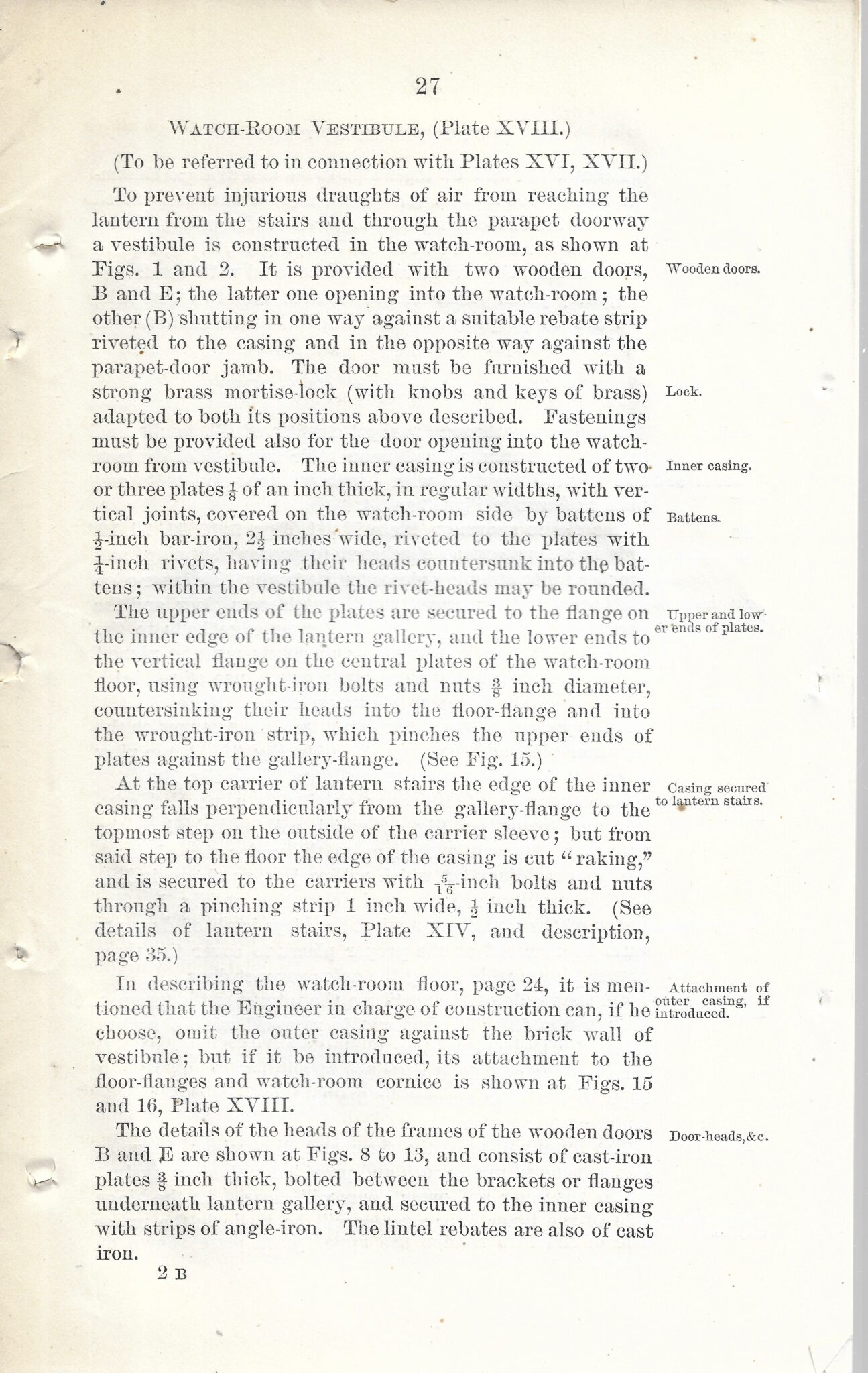

THe Decaying Wooden Door
Identical language for both towers’ written specifications leads us to believe that the other “twin” lighthouses to Currituck Beach (Morris Island, SC; St. Augustine, FL; Pigeon Point, CA; and Yaquina Head, OR) would also have had this wooden door at the top.
We checked with our twins – Bodie Island, St. Augustine, Yaquina Head, Pigeon’s Point, and Morris Island – to see what we could learn about any of the other extant doors, but none of them had a second door. And probably for good reason – there is a lot about it that makes removing it and preserving or reconstructing it a specialty job. Over the years, the Outer Banks Conservationists (OBC) and our lighthouse keeper have made efforts to mitigate the wood rot damage on this unique door without removing the door, but last year a soft spot of rot had gotten to the point that the original door needed to be taken off and down for work.

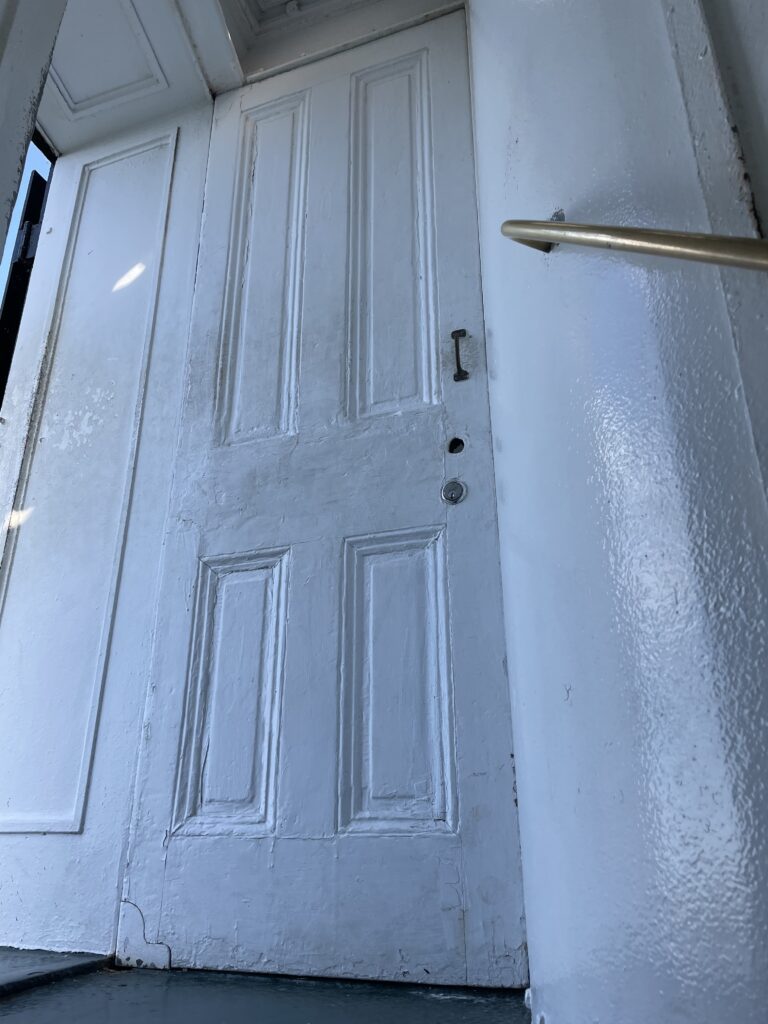
It was time to take take another tact – use the door itself to learn decide what to do and how to preserve having a second door in place. We asked local historic-preservationist Chris Thompson to take it down and examine it.
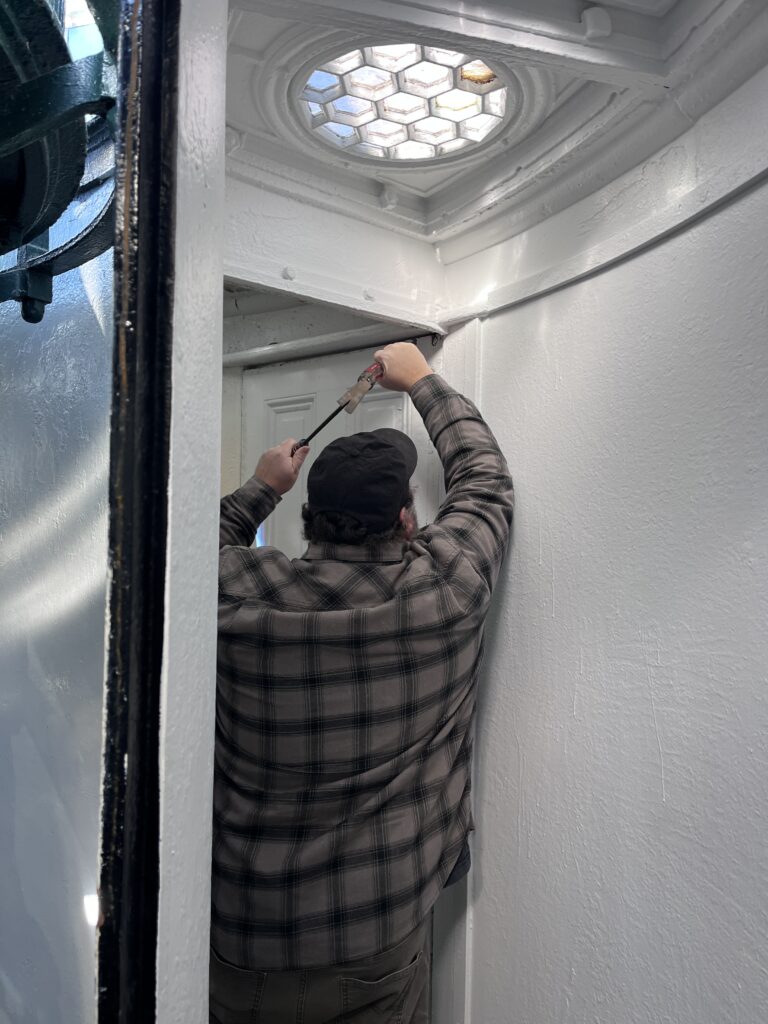

Because our other wooden door to the watch room does not lock, we were going to need this back in place for the opening of the 2025 season. We came to the decision to reproduce the door first and perhaps make the effort with more time to disassemble and strip the paint and replicate the non-rotted parts of the original door and recreate it with any salvageable pieces at a later date, using epoxies and dutchman repairs to bring it back to life.
Here’s what we knew in advance (although couldn’t necessarily see all of):
“On the inside of the vestibule the returns of the parapet-door jambs differ in that one is recessed with a square rebate for the wooden door to shut into, while the other is rounded out and lined with brass into which the hinged edge of the door accurately fits and turns.”
Brass Door Jams, Pivots & Pintles
Once the door was off and some paint removed, we could see that indeed the jamb for the door was brass.
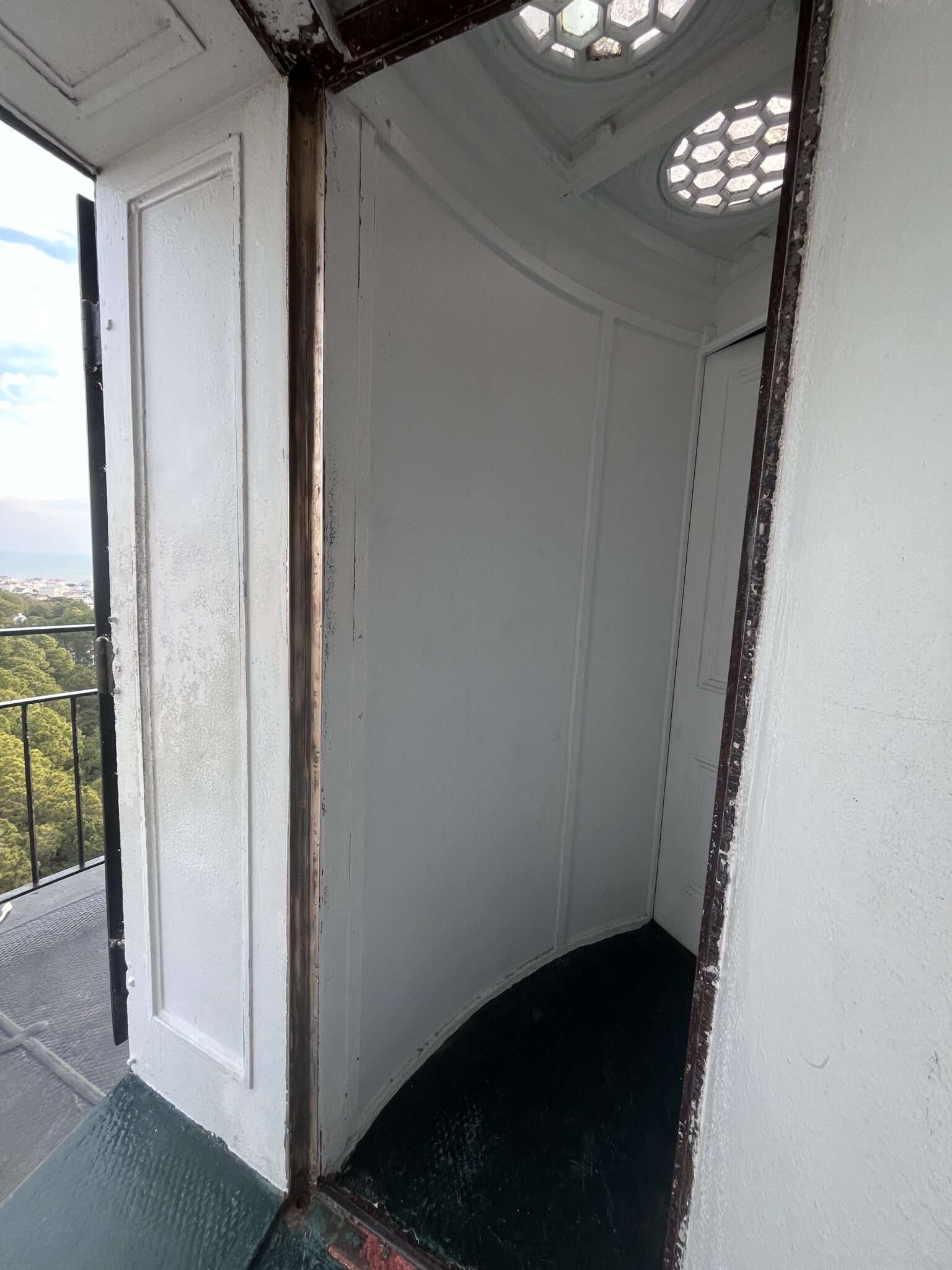
“DOOR-PIVOTS OR PINTLES, – At the head and heel of door a bronze box is fitted, each containing a steel pivot, as shown in Figs. 17 to 20.

“One check of the box is permanently screwed to the door, while the other may be removed in order to adjust the steel pivots by inserting suitable washers. The boxes are made “right and left,” in order to remove both the checks from the same side of the door. The cove of the door-jamb is lined up and down the hinged edge of door with brass 3/16 inch thick, secured with counter-sunk tap-screws 3/16 inch or ¼ inch diameter. Steel pintle-plates are fitted into and secured to the lintel and the watch-room floor, to confine the pivots.”
Replicating the Original Lighthouse Door & Hardware
Using the original dimensions and plans, Chris replicated joinery methods, including mortise and tenon. (This allows the door to be disassembled and repaired if need be in the future, but doesn’t involve any modern adhesives or glues.)
The hinge was unlike anything he’d seen: a two-piece pintle hinge with the door sandwiched between massive bronze knuckles. Screws were custom-machined, varying by location—wrought iron for some, wood screws, and metal screws—8–10 per hinge.
The pintles were steel (maybe because iron would have been too soft), height-adjustable with shims that fit on the inside that were the same diameter of the pintle so you could take the whole assembly apart and adjust the height depending on how high you wanted the door to rest– one shim was handmade, though it might have been retrofitted later.
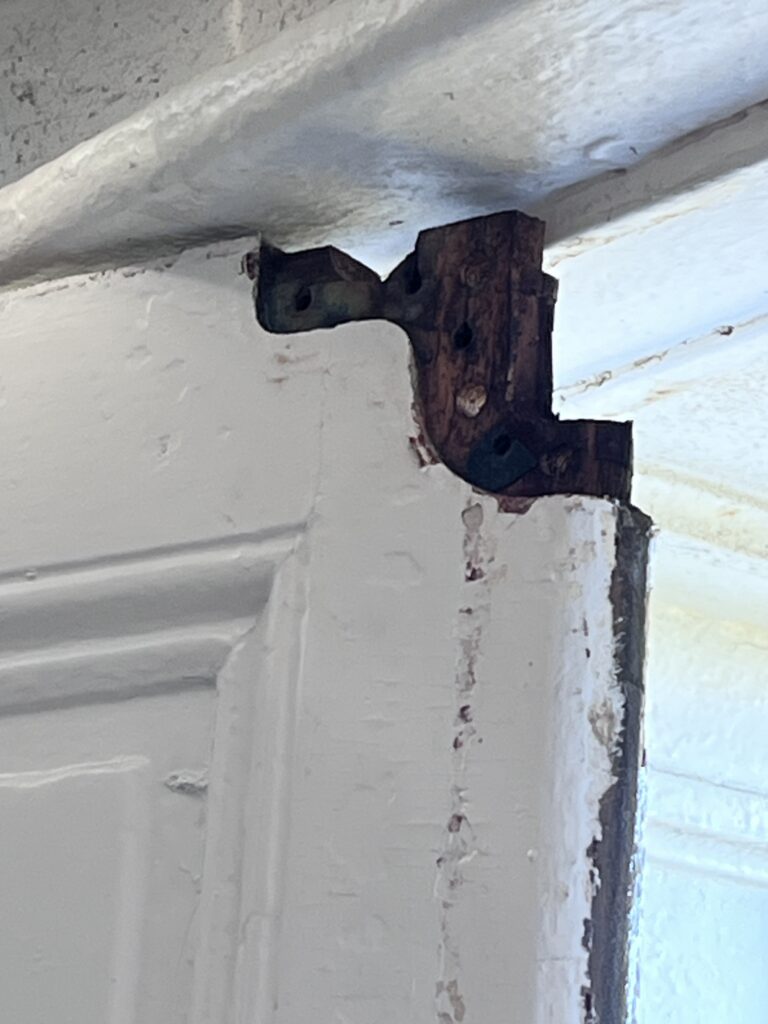
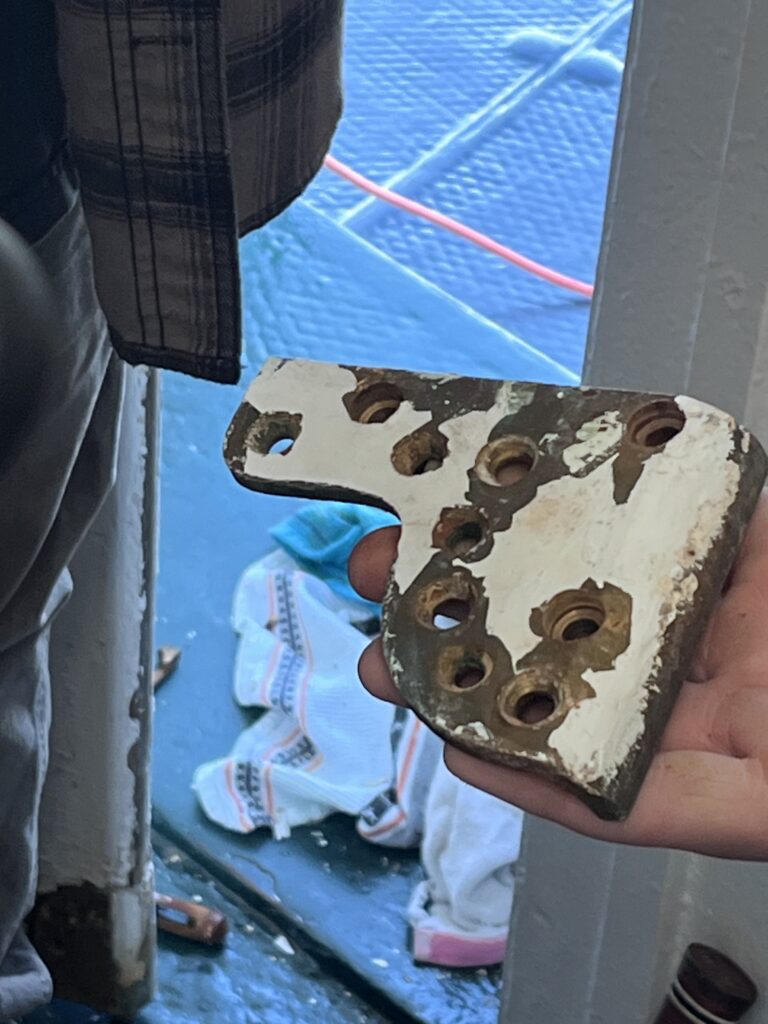
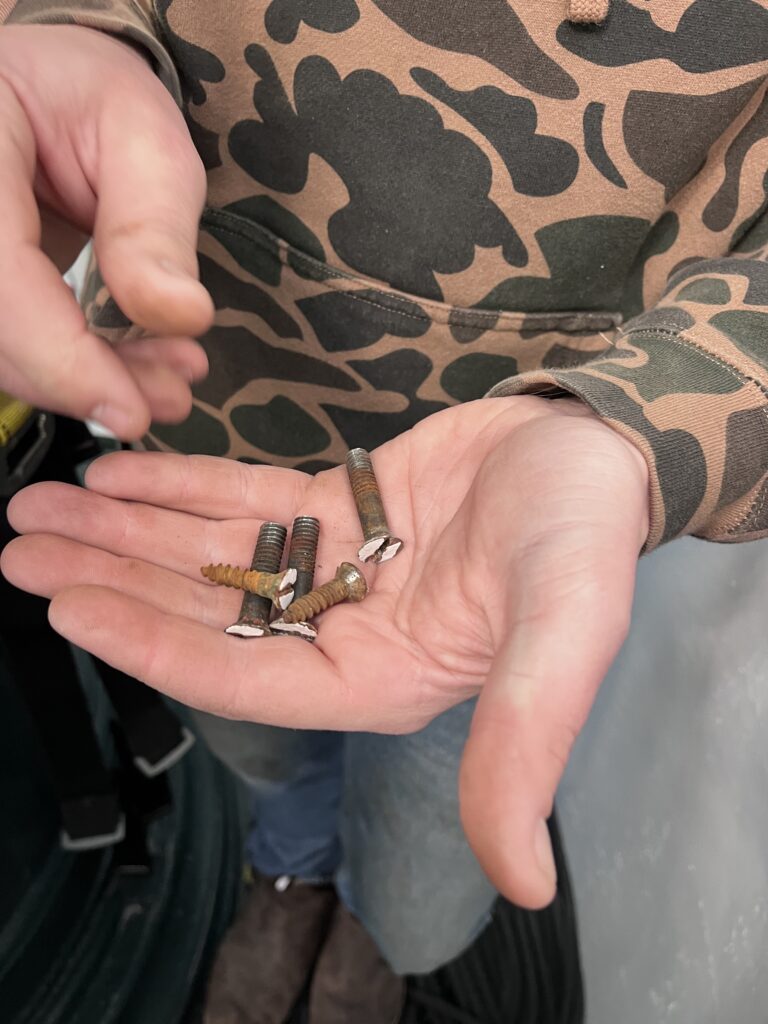
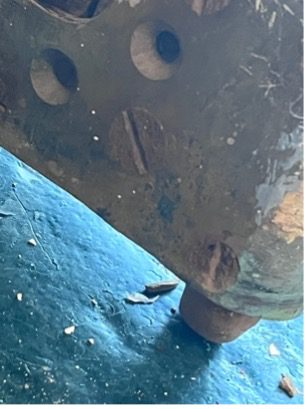
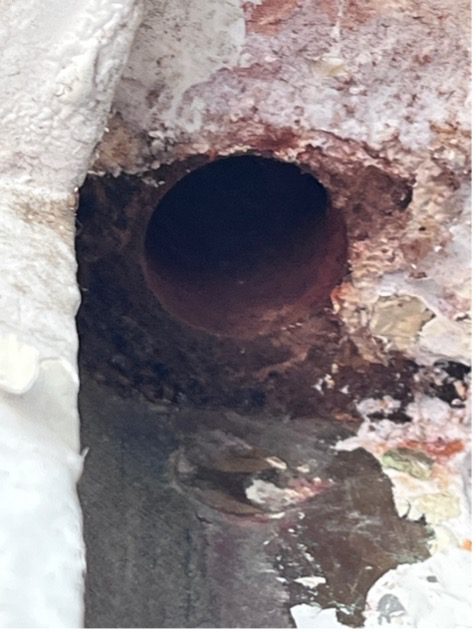
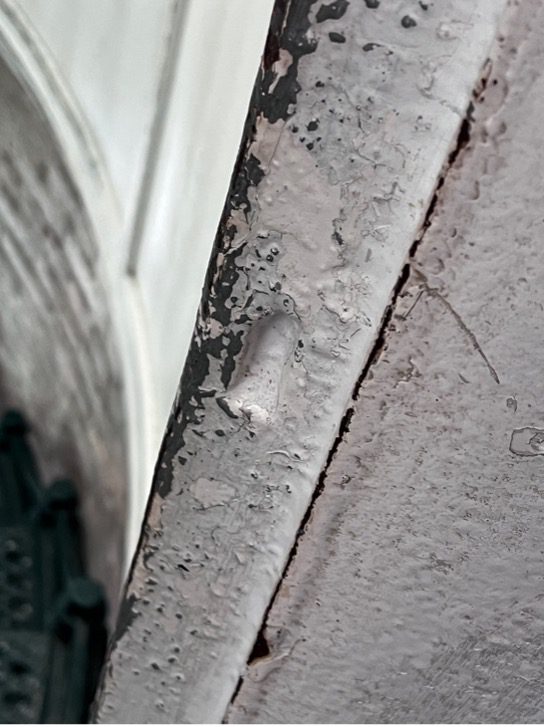
“It was so exceptional and heavy duty that it withstood 150 oceanfront years, another reason the screws were likely wrought and only one rusted and one broke – all others I cleaned up and reused, but also interestingly they weren’t bronze like the knuckles of the hinges. Plus it’s wild how wrought went into bronze and didn’t oxidize so it actually HAD to be wrought. Otherwise we know contact with dissimilar metals would have rusted the iron.” -Chris Thompson

THe Mysterious Lock
The lock proved the hardest mystery:
“I was flying blind – the way that that door fits into entirely different sections of jambs -when its closed it does not fit the same way in each one and I don’t know how one specific lock would work when there is no hole or strike on one jamb while while there was on the other one.”
Chris Thompson
Chris speculates a deep-set rim lock with a knob might have worked.
New Reproduction Door Installation
This spring Chris delivered a new door for us made of sapele (a stable mahogany), which is both rot and insect resistant. It was reinstalled just in time for the 2025 season. Chris had also sent away a paint chip for a paint report and color match.
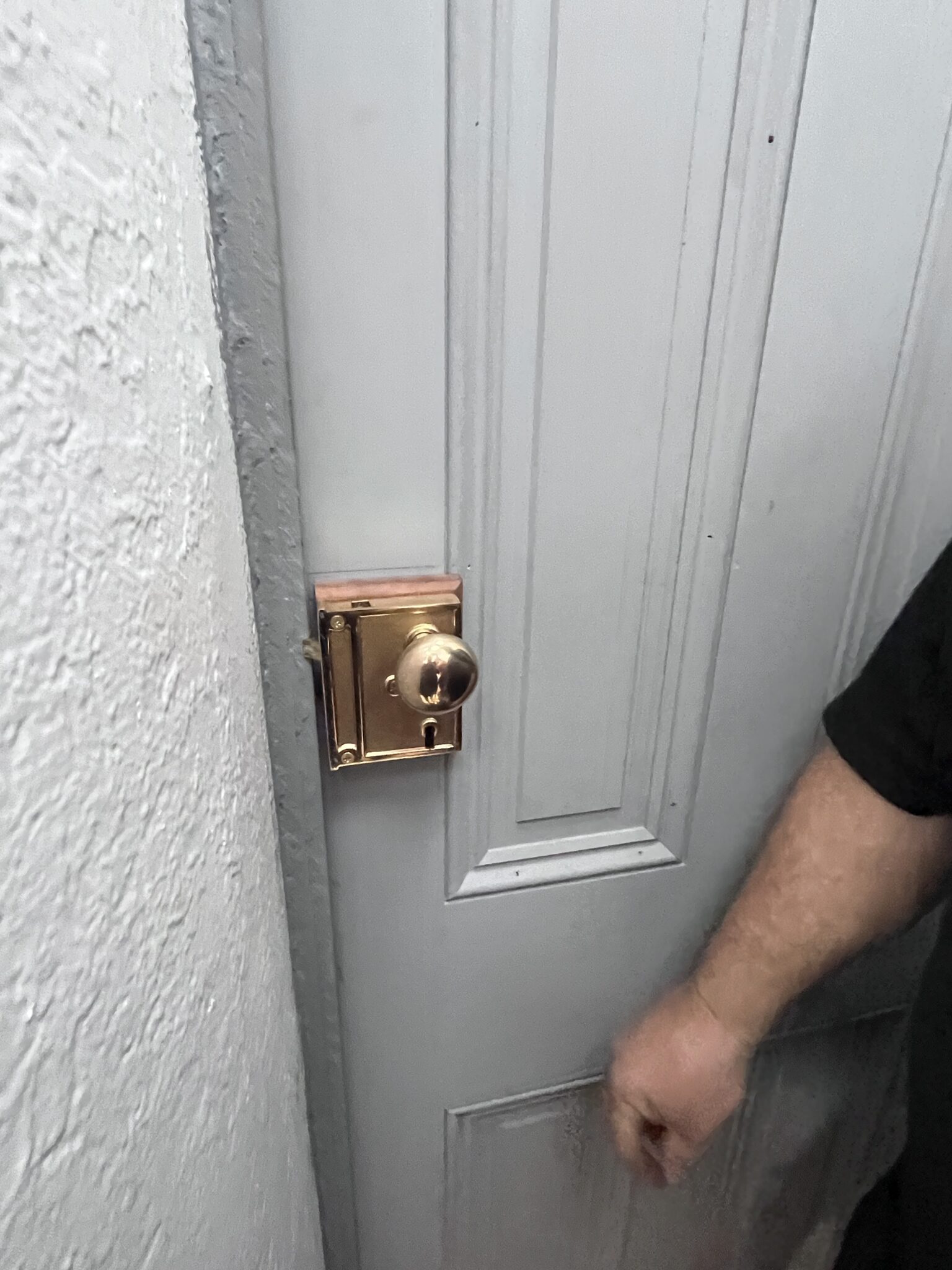
He learned that the door was originally painted a “moderate dark brownish red.”(Munsell Conversion Number: 6.05R3.56/2.03). Because the mortise lock Chris found had to be placed on an additional piece of wood to latch on the far side of the jamb that has no notch (so it has to catch behind the jamb), he then fabricated extra long keys for it.
But still we would love to locate original hardware. If anyone has photos of this door in our twins from long ago (which we realize is unlikely) or knows whether perchance Sand Island still has this door in place, please reach out!

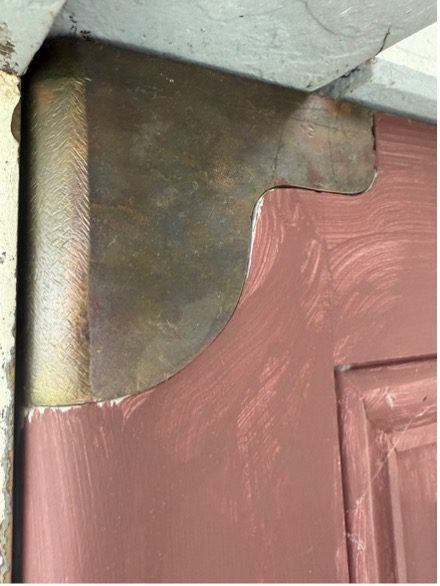
And in the meantime, we are open for the season and happy to have the door back in place “[t]o prevent injurious draughts of air from reaching the lantern from the stairs and through the parapet doorway.”

